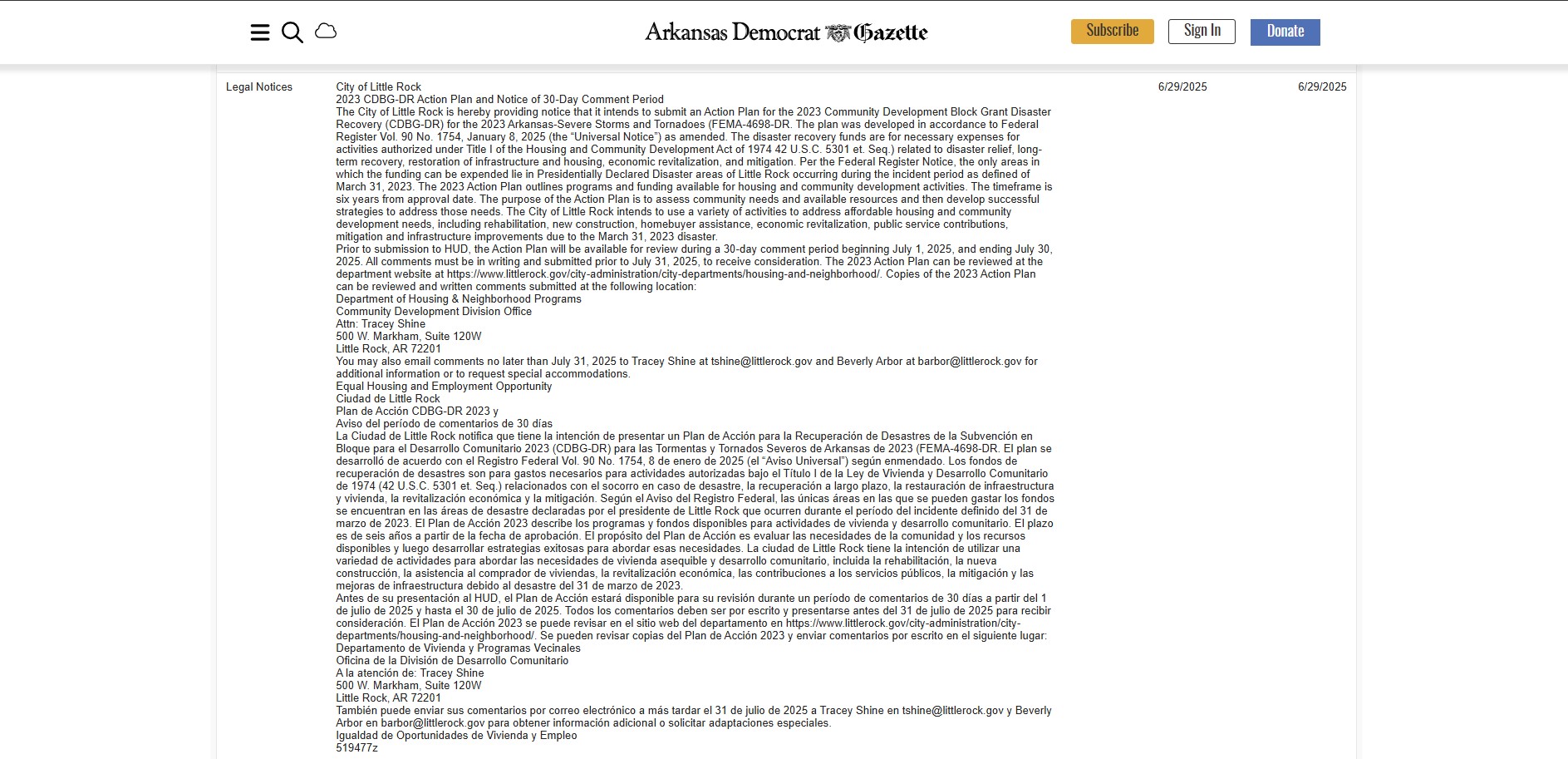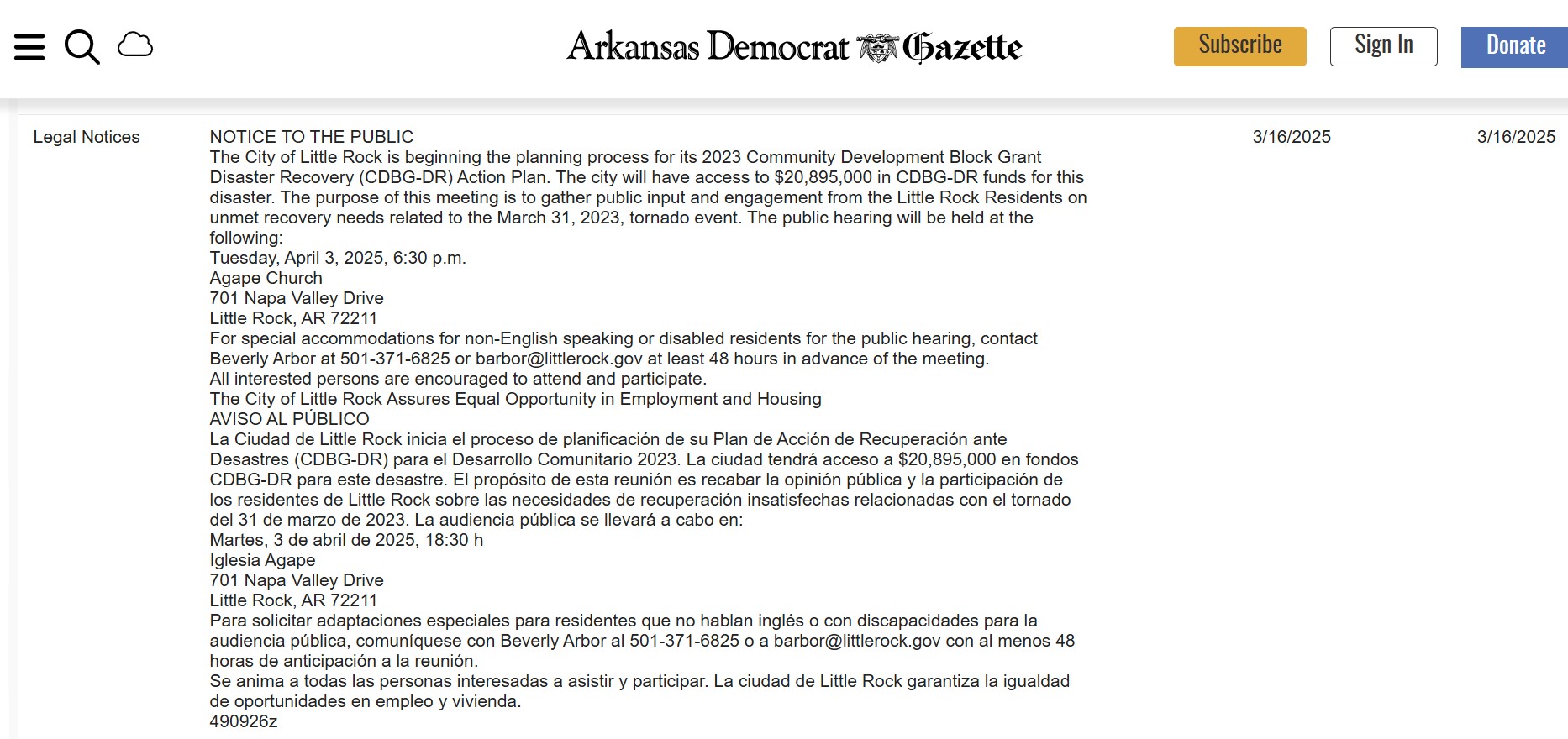
Under the Federal Register Notice, Little Rock is eligible to receive an allocation of $20,895,000 in disaster recovery funds for necessary expenses for activities authorized under Title I of the Housing and Community Development Act of 1974 (42 U.S.C. 5301 et. Seq.) related to disaster relief, long-term recovery, restoration of infrastructure and housing, economic revitalization, and mitigation. Per the Federal Register Notice, the only areas in which the funding can be expended lie in Presidentially Declared Disaster areas of Little Rock occurring during the incident period as defined of March 31, 2023.
June 29, 2026: The City of Little Rock has received HUD approval to increase the maximum household income eligibility for the CDBG-DR Homeownership Assistance Program from 120% to 150% of the Area Median Income (AMI).
April 6, 2026: The CDBG-DR Home Rehabilitation Program (HRP), Home Assistance Program (HAP), and New Affordable Housing Construction Program (NAHCP) are now live. Applications are currently available for HRP and HAP. The NAHCP procurement opportunity will be released at a later date; however, developers may review the Policy and Procedures Manual for program guidelines in the meantime.
March 31, 2026: During the anniversary of the 2023 tornado, The City of Little Rock plans to launch the Housing application for CDBG-DR. Please continue to check back for updates.
September 19, 2025: City of Little Rock executes the grant agreement with HUD, obligating funds to Program.
August 1, 2025: The City of Little Rock successfully submitted the CDBG-DR Action Plan to HUD on August 1st, 2025. There is a 45 day review period. Please continue to check back for updates.
January 16, 2025: A new Community Development Block Grant Disaster Recovery (CDBG-DR) allocation notice was released by the U.S. Department of Housing and Urban Development (HUD) in the Federal Register Notice.
This program is funded to address the unmet needs resulting from the 2023 tornado. Through the Homeowner Rehabilitation/Reconstruction Program, eligible households may receive assistance to repair, reconstruct, or replace their homes, or receive reimbursement for eligible repair, rehabilitation, or reconstruction costs incurred before applying for CDBG‑DR assistance. Applications opened on April 6, 2026, and will remain open until available funding has been exhausted or the program is otherwise closed by the City.
CDBG‑DR Allocation Amount: $4,503,250
- Maximum assistance is $350,000 per household for rehabilitation.
- The maximum assistance for reimbursement of prior costs is $50,000 per household.
The Homeowner Rehabilitation Program (HRP) provides financial assistance to eligible homeowners and rental property owners whose properties were damaged by the March 31, 2023 tornado. Meeting the basic eligibility requirements below does not guarantee assistance. All applications are subject to verification, environmental review, duplication of benefits (DOB) review, funding availability, and final approval by the City of Little Rock. Additional eligibility requirements and Program policies apply. Please refer to the Homeowner Rehabilitation Program Manual for complete eligibility requirements, Program policies, and funding limitations.
- Own property located within the City of Little Rock at the time of the March 31, 2023 tornado and continue to own it.
- Homeowners must also:
- Have occupied the property as their primary residence at the time of the March 31, 2023 tornado.
- Occupy the property as their current primary residence or, if temporarily displaced because of the disaster, demonstrate an intent to return and occupy the home as their primary residence after repairs are completed.
Not use the property as a second home, vacation home, or seasonal residence.
- Rental property owners must also:
- Own an eligible long-term residential rental property.
- Meet all applicable Program requirements for rental properties, including affordability and occupancy requirements.
- Not displace or evict tenants in order to qualify for assistance.
- Have disaster-related damage caused by the March 31, 2023 tornado.
- Have a household income at or below 150% of the Area Median Income (AMI).
- Be able to verify legal ownership of the property and be current on any mortgage & property taxes or participating in an approved repayment, forbearance, or loss mitigation agreement.
- Demonstrate an eligible unmet need after insurance, FEMA, SBA, and any other disaster assistance have been considered.
Meet all applicable Program and federal requirements.
- How do I apply?
Applications will be available online through the City’s website at littlerock.gov/cdbg-dr. You can also contact staff for assistance at cdbgdr@littlerock.gov.
- What documents will I need?
During the pre-screening, you will only need to provide proof of identity. If you are pre-approved, you will be invited to complete the full application. At that stage, you may be asked to provide:
- Proof of ownership
- Proof that the home was your primary residence at the time of the March 31, 2023 tornado and is your primary residence today (unless applying as an eligible rental property owner)
- Income documentation
- Insurance claim documents
- FEMA and/or SBA documentation (if applicable)
- Property tax information
- Mortgage information
- Receipts, invoices, and proof of payment for completed repairs (for reimbursement requests)
- Any additional documentation needed to determine program eligibility
- What types of repairs does the program cover?
The program may assist with eligible disaster-related repairs such as:
- Roof repairs or replacement
- Structural repairs
- Foundation repairs
- Electrical systems
- Plumbing
- HVAC systems
- Windows and exterior doors
- Drywall and insulation
- Flooring damaged by the tornado
- Other health and safety repairs directly related to tornado damage
Repairs must be determined eligible through the program inspection and environmental review process.
- What is not covered?
Generally, the program does not pay for:
- Home improvements or remodeling
- Luxury upgrades
- Cosmetic improvements unrelated to tornado damage
- Landscaping
- Tree replacement
- Fencing
- Detached sheds or other non-essential structures
- Personal property
- Repairs already paid for by insurance or another funding source
- What is a Duplication of Benefits (DOB)?
Federal law requires the City to review all disaster assistance you received, including:
- Insurance
- FEMA
- SBA disaster loans
- Other federal, state, local, nonprofit, or charitable assistance
The program can only pay for eligible unmet needs that have not already been covered by another funding source.
- Can I receive assistance if I had insurance?
Yes. Having insurance does not automatically make you ineligible. However, federal law does not allow the program to pay for repairs that were already paid for by insurance, FEMA, SBA, or another source. This is called a duplication of benefits (DOB) review. If you still have unmet eligible repair needs after all other assistance has been considered, you may qualify for assistance.
- Can I be reimbursed for repairs I’ve already completed?
Possibly. If you already paid for eligible tornado-related repairs, you may qualify for reimbursement. You must provide documentation such as:
- Receipts
- Proof of payment
- Contractor invoices
- Before and after photos (if available)
- Insurance information
- Any other documents requested by the program
Reimbursement cannot duplicate assistance already received from insurance, FEMA, SBA, or another source
- My insurance and other sources didn’t pay enough. Can I still qualify?
Yes. Many applicants receive partial insurance settlements that do not cover all eligible repairs. If you have remaining eligible unmet needs after insurance and other disaster assistance are considered, you may still qualify.
- How long does the process take?
Every application is different. The timeline depends on factors such as:
- Application completeness
- Income verification
- Environmental review
- Duplication of Benefits review
- Property inspection
- Scope of work development
- Procurement
- Contractor availability
Applicants will be notified as their application progresses.
- What if my contractor did poor-quality work or never finished the repairs?
The City will review your situation to determine whether any remaining eligible tornado-related damage may qualify for assistance. Federal rules generally do not allow the program to pay twice for work already covered by another funding source.
- Will I be able to choose my own contractor?
No. The City will select contractors through its procurement process in accordance with federal, state, and local requirements.
- What happens after I apply?
After your application is received, the City will:
- Review your application for completeness.
- Verify eligibility.
- Conduct a duplication of benefits review.
- Schedule an inspection (if applicable).
- Complete the required environmental review.
- Develop the scope of work.
- Procure a contractor.
- Begin construction after all federal requirements have been satisfied.
The New Affordable Housing Construction Program is intended to address an unmet need regarding affordable housing that was exacerbated by the March 2023 tornado. This program will fill additional gaps in housing need where rehabilitation/reconstruction is not enough to meet housing recovery needs. Under this program, The City of Little Rock will support the construction of affordable housing units (including single-family, small rental, or multi-family housing). The City of Little Rock will provide funds to developers for projects in the form of a subsidy or loan. Affordable housing units may be developed on land that includes, but is not limited to, City acquired/owned land. Homes will be constructed and sold/rented at affordable prices to eligible households. The maximum assistance is $400,000 per unit.
CDBG‑DR Allocation Amount: $6,500,000
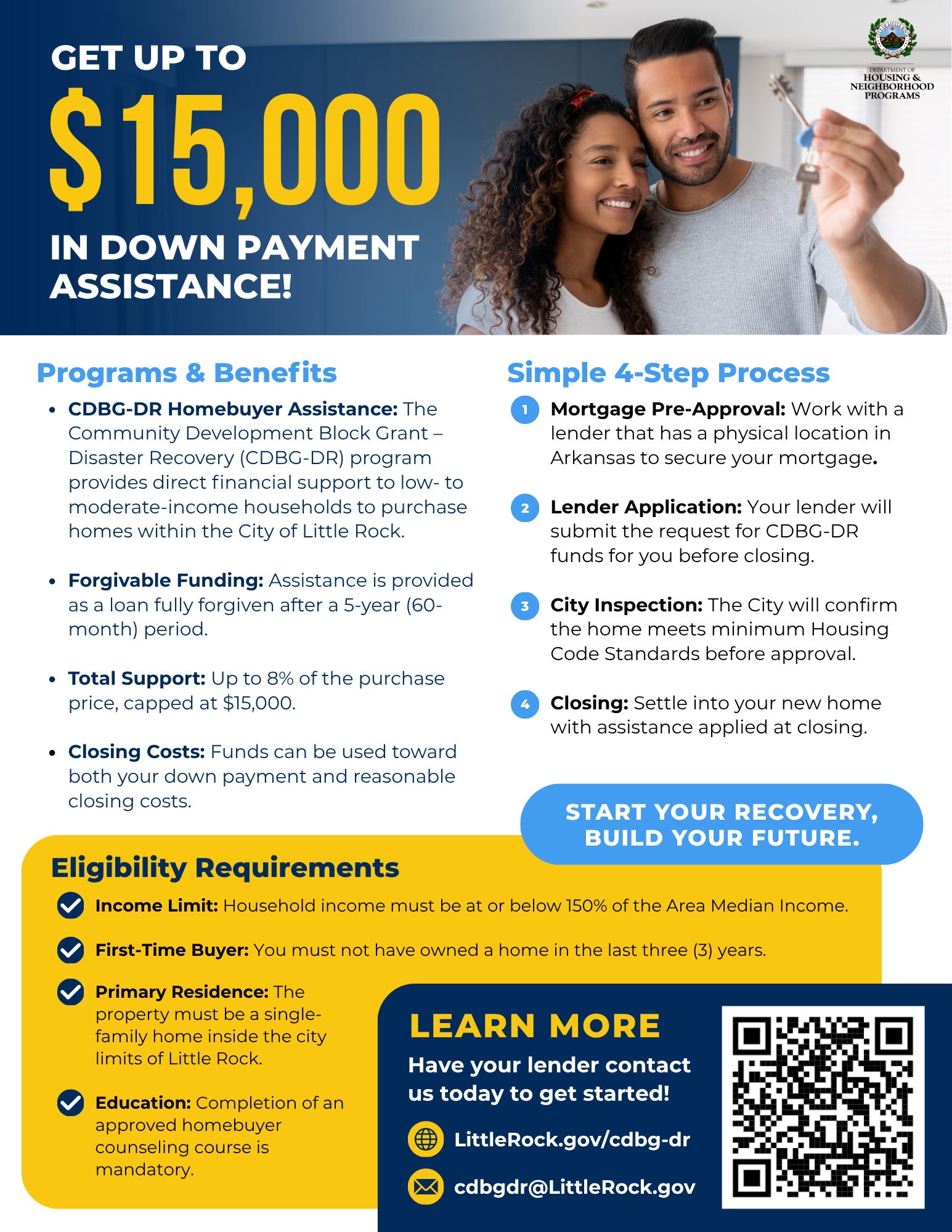
The Homebuyer Assistance Program provides direct financial assistance to eligible homebuyers to support the purchase of a home. Assistance may be used for down payment and reasonable closing costs and is provided as a forgivable loan. A deed restriction will be placed on the property based on the amount of assistance provided.
CDBG‑DR Allocation Amount: $1,000,000
- Maximum assistance is the lesser of $15,000 or 8% of the purchase price.
- Assistance is provided as a forgivable loan that is forgiven over 60 months (five years).
- Purchase a home located within the City of Little Rock.
- Be a first-time homebuyer, meaning the applicant has not had an ownership interest in a residential property within the past three years.
- Have a household income at or below 150% of the Area Median Income (AMI).
- Be a U.S. citizen or other individual eligible to receive federal public benefits.
- Qualify for a mortgage through a participating lender.
- Complete a HUD-approved homebuyer education course.
- Occupy the home as their primary residence for at least five years.
- Meet all program eligibility and documentation requirements.
- What is a first-time homebuyer?
A First-Time Homebuyer (FTHB) is an individual who has not held an ownership interest in another property in the three years prior to the case number assignment. First-Time Homebuyer includes an individual who is divorced or legally separated and who has had no ownership interest in a Principal Residence (other than joint ownership interest with a spouse) during the three years prior to case number assignment.
- Do I need to qualify for a mortgage first?
Yes. Applicants must qualify for a mortgage through a participating lender before receiving HAP assistance.
- Can I use this program with other down payment assistance programs?
HAP generally cannot be combined with another program that provides assistance for the same down payment or closing costs. However, it may be combined with programs that provide assistance for a different purpose, such as an interest rate reduction, provided there is no duplication of federal benefits.
- What happens if I sell the home before five years?
If you sell or transfer the property before the end of the five-year affordability period, you may be required to repay the unforgiven portion of the assistance in accordance with the program requirements.
- How do I apply?
Applications are submitted through a participating mortgage lender. Once your lender has determined that you qualify for a mortgage, they will submit your HAP application and required documentation to the City of Little Rock for review.
- Is homeowner’s insurance required, and does the City need to be listed on the policy?
Yes. Homeowners are required to maintain homeowner’s insurance on the assisted property for the duration of the City’s period of affordability. However, the City of Little Rock is not required to be listed as a mortgagee or additional insured on the homeowner’s insurance policy.
- Will the City place a lien on the property?
Yes. As a condition of receiving Homebuyer Assistance, the City of Little Rock will record a mortgage lien and deed restriction against the assisted property. The City’s lien must be listed in no lower than second position, generally subordinate only to the homebuyer’s primary mortgage. The lien and deed restriction will remain in effect for the applicable period of affordability and will be released upon successful completion of all program requirements.
The Infrastructure Program is designed to restore and enhance publicinfrastructure systems that sustained damage as a result of DR-4698. The program will prioritizecritical infrastructure investments that address urgent health and safety needs and improveresiliency to future disasters. Eligible activities may include but are not limited to repair,replacement, or relocation of public facilities and systems, demolition and rehabilitation ofpublicly- or privately-owned commercial or industrial buildings, debris removal, and implementingnatural and green infrastructure.
CDBG‑DR Allocation Amount: $2,500,000
The Mitigation Program is designed to reduce the risk and impact of future disasters by investing in resilient infrastructure systems, with a primary focus on stormwater management and critical public facilities. The program’s purpose is to support long-term recovery by addressing vulnerabilities exposed by the tornado. The program will prioritize projects that mitigate storm risk, manage stormwater and debris more effectively, and strengthen critical public systems that are essential for community health and safety.
How will Program Advance Long-Term Resilience: City of Little Rock recognizes the importance of resiliency against future storms and will rely on City engineers to guard against premature obsolescence of infrastructure and ensure that the construction or rehabilitation of infrastructure will mitigate against future disasters. City of Little Rock will describe the implementation of utilizing these technologies, when applicable, in its program policies and procedures.
How will Program Address Disaster-Related Stormwater Management/Other Systems: Flooding has been identified as one of the most destructive hazards in terms of loss of human life, injury, and property damage. Enhancing the function of natural flood mitigation features such as streams and wetlands to ensure that conveyed water makes it to rivers and other bodies of water is increasingly important. Stormwater management is also a major issue for inland communities. Funding for implementing flooding mitigation projects is critical to achieving the state’s lifeline objectives. City of Little Rock will encourage vendors to identify and select stormwater infrastructure improvement projects that address remaining unmet needs.
CDBG‑DR Allocation Amount: $3,147,000
The Economic Revitalization Program is designed to support the recovery and long-term resilience of the local economy impacted by DR-4698. The program aims to support the businesses, workers, and commercial districts that suffered economic disruption of physical damage, while laying the foundation for sustainable economic growth across the community. The program focuses on job restoration and retention, workforce development, commercial façade and infrastructure improvements.
CDBG‑DR Allocation Amount: $1,500,000
The CDBG-DR Public Services Program provides services that help address unmet needs resulting from the March 31, 2023 tornado. Eligible activities may include disaster case management to help households navigate recovery resources, housing assistance, and social services; legal services related to housing issues, insurance claims, FEMA appeals, landlord-tenant matters, and heir property issues; and mental health and crisis counseling, including trauma-informed care and referrals for individuals and families affected by the disaster.
The program may also support services for people experiencing homelessness, including outreach, shelter diversion, and other assistance to help prevent homelessness among disaster-impacted households. Additional eligible activities may include food and nutrition assistance, such as meal delivery, mobile food pantries, and food distribution; medical and health services, including non-duplicative mobile clinics, health screenings, and community health outreach in areas where services were disrupted by the disaster; workforce support services, such as childcare and transportation that help displaced workers access or maintain employment; and services for older adults and persons with disabilities, including in-home assistance, transportation, and case management to address mobility and accessibility needs.
All Public Services activities must meet CDBG-DR eligibility requirements, address an unmet disaster-related need, and cannot duplicate assistance available through insurance, FEMA, SBA, or any other source.
CDBG‑DR Allocation Amount: $500,000
All projects receiving CDBG-DR assistance are subject to the federal environmental review requirements under the National Environmental Policy Act (NEPA) and HUD’s environmental review regulations at 24 CFR Part 58. Before federal funds can be committed or construction may begin, the City of Little Rock must complete the appropriate environmental review. The City’s completed Environmental Review Records (ERRs) are available through HUD’s Environmental Review Online System (HEROS), which houses environmental reviews made publicly available, including Environmental Assessments (EAs), Categorically Excluded Subject to § 58.5 (CEST) reviews, and CEST reviews that converted to exempt. The Tier I and Tier II Environmental Reviews for the City of Little Rock’s CDBG-DR programs and projects are also provided below for public review. For more information about HUD’s environmental review requirements and to search Environmental Review Records, visit the HUD HEROS website.
- Phase I Environmental Site Assessment (ESA) with Attachments – 10702 Breckenridge, Little Rock, AR – August 2026
- Phase I Environmental Site Assessment (ESA) with Attachments – 1216 Shackleford Road Little Rock, Arkansas – August 2026
- Notice of Intent to Request Release of Funds [Tiered Reviews] – NAHCP, HRP, HAP, Infrastructure, & Mitigation – February 15, 2026
CDBG-DR funding is authorized under the Housing and Community Development Act of 1974 and is governed by federal laws, HUD regulations (24 CFR Part 570), and disaster-specific requirements. HUD provides program guidance and updates through Allocation Announcement Notices (AANs), memoranda, and CPD Notices, which establish funding requirements, waivers, alternative requirements, and implementation guidance to support disaster recovery efforts. https://www.hud.gov/hud-partners/community-cdbg-dr-regulations
The City of Little Rock uses an online bidding platform (LRProcure) to solicit quotes and post bid notices. Registered vendors are automatically notified when a solicitation matches their selected goods or services via Commodity Codes. Rules governing purchasing and contract procedures were established under the concept of open bidding, and in accordance with applicable laws, statutes, and ordinances. Purchase awards are made to the lowest responsible vendor who meets City of Little Rock specifications and has the capacity to deliver the product or service. The City of Little Rock only receives bid responses through the City’s Procurement Portal. No paper or email bids will be accepted. Additional information can be found directly on CLR Procurement page. Visit the Procurement Portal for information about open bid opportunities.
- NeighborlySoftware Saas – Contract – Software
- Guidehouse – Contract – Training
- Guidehouse – Contract – Review of Policy and Procedure
- Guidehouse – PO – LMI Waiver
- Guidehouse – PO – Action Plan
- McLarty – PO – New Vehicle Purchase
- ECCI – Phase I – Shackleford
- ECCI – Phase 1 – Breckenridge
- Renaissance Construction – PO 30 Pleasant Cove